
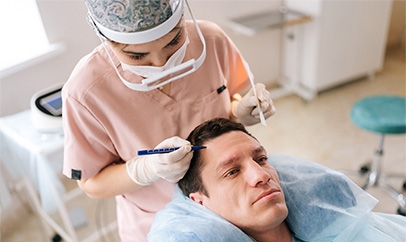
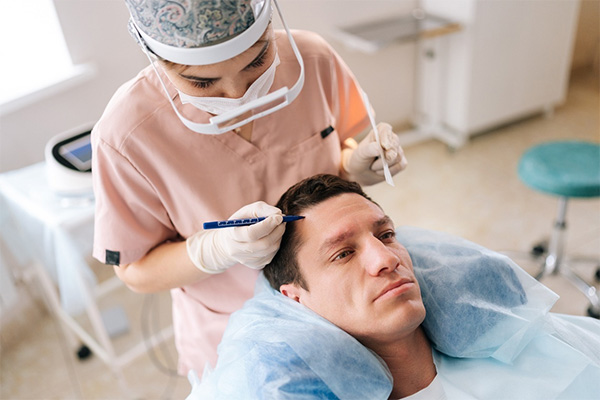
Hair loss can gradually change more than your appearance. It can affect confidence, hairstyles, and how you feel when looking in the mirror. While medications, PRP, laser therapy, and other nonsurgical treatments can help certain patients, they may not restore hair where follicles have permanently disappeared. Hair implant surgery offers another approach by relocating healthy follicles to thinning areas. Here is why patients may consider hair implant surgery in Newport Beach and Beverly Hills.
What Makes Hair Implant Surgery Different?
Hair implant surgery, commonly called hair transplantation, works by moving healthy hair follicles from a donor area, usually the back or sides of the scalp, into areas affected by permanent thinning or baldness. Unlike treatments designed primarily to support existing follicles, transplantation can add hair to areas where density has already been lost.
The goal is not simply to increase the number of hairs. Proper hairline design, follicle selection, placement angle, direction, and density all contribute to whether the result looks natural. These considerations make hair transplantation both a medical procedure and an aesthetic process.
Hair Implant Surgery vs. Nonsurgical Hair Restoration
Nonsurgical options can be valuable, particularly when hair loss is relatively early or existing follicles can still be supported. We offer treatments including PRP, medical hair-loss management, low-level light therapy, laser hair restoration, and genetic testing.
However, these approaches are not interchangeable with transplantation. A patient with active shedding may benefit from medical management, while someone with established areas of permanent hair loss and adequate donor hair may be evaluated for surgery.
In some cases, combining approaches can make sense. Maintaining existing hair while restoring areas of lost density can provide a more comprehensive long-term strategy.
FUE Hair Transplant: A Minimally Invasive Surgical Option
Follicular Unit Extraction, or FUE, removes individual follicular units from the donor area and places them into areas requiring restoration. Because follicles are harvested individually, FUE does not create the linear donor scar associated with FUT. It can also be appropriate for patients who prefer shorter hairstyles.
FUE may be considered for restoring the hairline, temples, crown, or other areas, depending on the patient's donor supply and pattern of hair loss.
FUT Hair Transplant: When More Grafts May Be Needed
Follicular Unit Transplantation, or FUT, uses a different harvesting technique. A strip of hair-bearing scalp is removed from the donor region, and individual follicular units are prepared for transplantation.
One potential advantage is the ability to harvest a substantial number of grafts during a single procedure, which can make FUT useful for selected patients with more extensive hair loss or higher-density restoration goals. It does leave a linear scar, although surrounding hair may conceal it.
The choice between FUE and FUT should therefore be based on individual factors rather than assuming one technique is universally superior.
Why Newport Beach and Beverly Hills Patients May Prefer a Specialized Approach
Choosing a dedicated hair restoration practice can allow the evaluation to focus specifically on hair loss, donor availability, facial proportions, hair characteristics, and long-term restoration goals.
Pure Hair Restoration Center offers both FUE and FUT alongside nonsurgical treatments, beard and eyebrow transplantation, and other hair-loss services.
Is Hair Implant Surgery Right for Everyone?
Not necessarily. Good candidates generally need an appropriate pattern of hair loss, sufficient donor hair, and realistic expectations about what transplantation can achieve. The cause and progression of hair loss also matter.
A consultation can help determine whether surgery is appropriate or whether medical management, PRP, laser therapy, or another treatment should come first.
Frequently Asked Questions About Hair Implant Surgery
1. Is hair implant surgery permanent?
Transplanted follicles are generally selected from donor areas that are more resistant to androgenetic hair loss. When successfully transplanted, these follicles are intended to continue growing long term. However, surrounding native hair can continue thinning, so ongoing evaluation may still be important.
2. Is FUE better than FUT for hair transplantation?
Neither is universally better. FUE may suit people who prefer shorter hairstyles and want to avoid a linear scar, while FUT can be useful when a larger number of grafts is needed. The appropriate technique depends on donor density, hair-loss pattern, goals, and individual anatomy.
3. Can women have hair implant surgery?
Yes. Women can be candidates for hair transplantation when their pattern of hair loss, donor supply, and overall circumstances make surgery appropriate. A proper evaluation is important because female hair loss can have several causes.
4. How long does it take to see hair transplant results?
Hair growth occurs gradually. According to Pure Hair Restoration Center, new growth may begin around three to four months, with noticeable improvement developing around six months and fuller results typically appearing around nine to twelve months.
5. Can hair transplant surgery be combined with other hair-loss treatments?
Yes. Depending on the patient's needs, transplantation may be combined with treatments intended to support existing hair, such as medical management, PRP, or light-based therapies. The combination should be determined after evaluating the cause and progression of hair loss.
Consider a Personalized Hair Restoration Evaluation
Hair implant surgery is not automatically the best solution for every type of hair loss, but it can offer a lasting way to restore density when permanent hair loss and adequate donor hair make transplantation appropriate. Patients considering hair restoration in Newport Beach or Beverly Hills can begin with a personalized evaluation to understand whether FUE, FUT, nonsurgical treatment, or a combination offers the most appropriate path forward.
Authorship: Dr. Nader Ronaghi, MD is a board-certified physician and leading hair restoration specialist based in Newport Beach, California. A Diplomate of the American Board of Hair Restoration Surgery (ABHRS) and active member of the International Society of Hair Restoration Surgery (ISHRS), he brings over a decade of experience in advanced FUE and FUT hair transplantation, regenerative therapies, and aesthetic medicine. As Founder and Medical Director of Pure Hair Restoration in Newport Beach, Dr. Ronaghi is recognized for his meticulous technique, natural results, and commitment to innovation and patient-centered care.
Disclaimer
The information provided on this page is intended for educational purposes only and should not be considered medical advice. Always seek the guidance of a qualified physician regarding any medical condition or treatment.